Chainlist MetaMask TechEduByte: Complete & Accurate Guide to Adding Blockchain Networks Safely
Web3 is growing fast, and with that growth comes one major reality: users no longer stay on a single blockchain. One day you’re using Ethereum, the next day BNB Smart Chain, Polygon, Arbitrum, or another EVM-compatible network. In almost all of these cases, MetaMask acts as the gateway.
However, MetaMask does not come preloaded with most blockchains. By default, it only includes Ethereum Mainnet. Every other network must be added manually. This is where many beginners—and even experienced users—run into problems such as incorrect RPC URLs, wrong chain IDs, failed transactions, or security risks.
This is exactly where Chainlist MetaMask TechEduByte becomes relevant.
This guide is written to give clear, accurate, and practical information only. No speculation, no filler, no SEO gimmicks—just real explanations based on how MetaMask and Chainlist actually work. Whether you are new to Web3 or already active across multiple chains, this article will walk you through everything step by step.
What Is MetaMask and Why It Matters in Web3
MetaMask is a non-custodial cryptocurrency wallet that allows users to interact directly with blockchains and decentralized applications (dApps). It is available as a browser extension and a mobile app.
What MetaMask Actually Does
MetaMask allows users to:
- Store and manage crypto assets
- Connect directly to dApps without intermediaries
- Sign transactions using private keys stored locally
- Switch between multiple blockchain networks
- Add custom EVM-compatible chains manually
MetaMask does not control your funds. You alone hold your private keys and recovery phrase.
MetaMask’s Key Limitation
Despite its flexibility, MetaMask has one major limitation:
It does not include popular blockchains by default.
Networks such as:
- BNB Smart Chain
- Polygon
- Avalanche
- Arbitrum
- Optimism
must be added manually using network configuration details such as:
- RPC URL
- Chain ID
- Currency symbol
- Block explorer URL
This manual setup is where errors commonly occur.
What Is Chainlist and How It Works
Chainlist is a network directory that provides verified blockchain network configurations compatible with MetaMask and other Web3 wallets.
What Chainlist Actually Does
Chainlist allows users to:
- Search blockchain networks by name
- View verified RPC endpoints
- Add networks to MetaMask with one click
- Avoid manual copy-paste errors
- Reduce setup time and technical confusion
Chainlist does not access your funds, does not store private keys, and does not execute transactions.
Its only role is to send network configuration data to MetaMask after user approval.
Why Chainlist and MetaMask Work Best Together
Manually adding a network to MetaMask requires precision. One incorrect character in an RPC URL or chain ID can break network connectivity.
Chainlist solves this by:
1. Providing Verified Network Data
Chainlist displays accurate and updated information for EVM-compatible blockchains, reducing the risk of outdated RPC endpoints.
2. Eliminating Manual Errors
Instead of copying long RPC URLs from random sources, users can add networks with a single approval.
3. Saving Time
Switching between chains becomes fast and efficient, especially for users active in DeFi, NFTs, or Web3 development.
4. Improving Beginner Safety
New users avoid common mistakes that lead to failed transactions or wallet misconfigurations.
What Makes Chainlist MetaMask TechEduByte Different
Many online guides either oversimplify or overcomplicate the process. Chainlist MetaMask TechEduByte stands out because it focuses on accuracy, clarity, and real user problems.
Focus on Verified Practices
TechEduByte-style guidance emphasizes:
- Verified RPC endpoints
- Correct chain IDs
- Safe wallet interaction principles
Clear Explanations for Beginners
Instead of assuming prior knowledge, explanations include:
- Why each step is required
- What MetaMask is actually doing in the background
- What can go wrong and why
Covers Real Issues, Not Just Setup
Most guides stop at “network added successfully.” TechEduByte-style content goes further by explaining:
- RPC failures
- Network switching issues
- MetaMask mobile limitations
- Duplicate chain ID errors
Step-by-Step: How to Add a Network Using Chainlist and MetaMask
This process works similarly on desktop and mobile, with minor differences.
Step 1: Open the Official Chainlist Website
Use a modern browser such as Chrome, Firefox, or Brave.
Always ensure:
- The URL is correct
- The site loads properly
- No phishing pop-ups appear
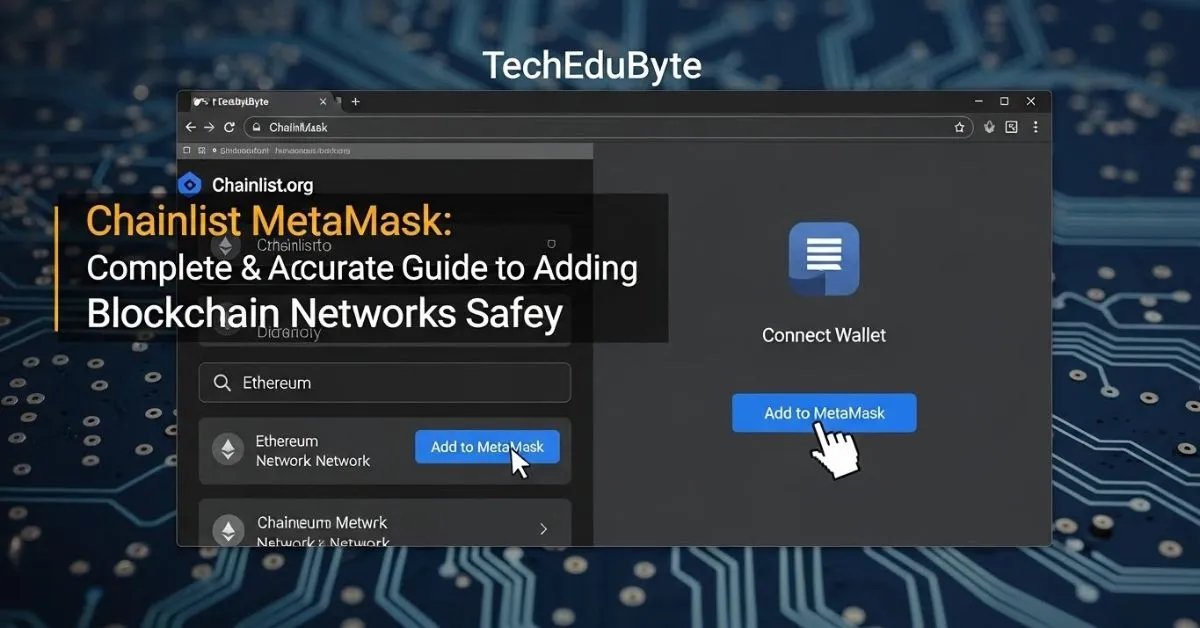
Step 2: Connect MetaMask Wallet
Click “Connect Wallet”.
MetaMask will ask for permission to connect.
This does not grant Chainlist access to:
- Funds
- Private keys
- Transaction approval
It only allows network configuration requests.
Step 3: Search for the Desired Network
Use the search bar to find networks such as:
- BNB Smart Chain
- Polygon
- Arbitrum
- Avalanche
Look for verified labels to ensure reliability.
Step 4: Add Network to MetaMask
Click “Add to MetaMask”.
MetaMask will display:
- Network name
- RPC URL
- Chain ID
- Currency symbol
- Block explorer
Review and approve.
Step 5: Switch to the New Network
MetaMask will prompt you to switch immediately or later.
Confirm when ready.
Step 6: Network Is Ready to Use
You can now:
- Send and receive tokens
- Connect to dApps
- Use DeFi platforms on the selected chain
Common Chainlist and MetaMask Issues (With Exact Fixes)
RPC URL Not Available
Cause: RPC endpoint temporarily overloaded or offline.
Fix:
- Refresh Chainlist
- Choose another verified RPC
- Restart MetaMask
“Add to MetaMask” Button Not Showing
Cause: Browser cache or extension conflict.
Fix:
- Clear browser cache
- Disable VPN
- Switch browsers (Chrome recommended)
Chainlist Cannot Connect to MetaMask
Cause: MetaMask locked or extension conflict.
Fix:
- Unlock MetaMask
- Reload the page
- Disable conflicting wallet extensions
Network Added but Not Visible
Cause: MetaMask UI delay.
Fix:
- Open network dropdown manually
- Restart browser
- Restart MetaMask extension
Transactions Failing After Network Addition
Cause: Slow or unreliable RPC.
Fix:
- Switch to another verified RPC
- Avoid community RPCs during high traffic
- Retry transaction after network refresh
Chainlist on MetaMask Mobile: Important Limitations
MetaMask mobile works differently from desktop.
Key Points to Remember
- Use MetaMask’s internal browser
- External mobile browsers may not connect properly
- Some networks may require manual confirmation
Chainlist works best when accessed directly inside MetaMask mobile.
Security Considerations When Using Chainlist
Chainlist itself is safe, but users must still follow good security practices:
- Never approve unknown transaction requests
- Never share recovery phrases
- Avoid unofficial RPCs
- Double-check network names before approval
Chainlist only handles network data, but wallet security remains the user’s responsibility.
Why Chainlist Is Preferred Over Manual Network Setup
Manual setup is error-prone and outdated information is common.
Chainlist offers:
- Centralized verified data
- Faster configuration
- Reduced technical risk
- Better beginner experience
For most users, Chainlist is the safest and simplest option.
Conclusion
Using multiple blockchains is now standard in Web3. MetaMask provides flexibility, but network setup remains a challenge for many users. Chainlist solves this problem by offering verified, accurate, and easy network additions.
Chainlist MetaMask TechEduByte represents a practical, documentation-style approach—focused on real usage, safety, and clarity. Whether you are new to crypto or managing multiple networks daily, using Chainlist with MetaMask ensures accuracy, speed, and confidence.
FAQs
1. Is Chainlist safe to use with MetaMask?
Yes. Chainlist does not access funds or private keys. It only sends network configuration data to MetaMask after user approval.
2. Can Chainlist steal my crypto?
No. Chainlist cannot sign transactions or move funds.
3. Does Chainlist work on MetaMask mobile?
Yes, but it works best inside MetaMask’s built-in browser.
4. What is an RPC in MetaMask?
RPC is a connection endpoint that allows MetaMask to communicate with a blockchain network.
5. Is manual network setup better than Chainlist?
Manual setup works, but Chainlist is safer, faster, and reduces errors for most users.












Post Comment